
Fluted and Ribbed Wardrobe Shutters: Routed MDF, Profiled Laminates and Wood Slats
Fluted wardrobe shutters compared: CNC-routed MDF, fluted laminate, veneered slats and glass, with groove depth limits, dust care and Nov 2026 prices.
In this guide 7 sections
Fluted wardrobes are everywhere in new Indian bedrooms. A row of vertical grooves catches the light, adds shadow and makes a wall of shutters feel taller and more crafted.
But "fluted" can mean very different products at very different prices, and a badly made one can bow, show crooked joints or trap dust. Here are the options, the details that matter, and November 2026 prices.
Fluted, Reeded, Ribbed, Slatted: What the Words Mean
Showrooms use these words loosely, which causes real mistakes in quotes. Strictly:
- Fluted: concave grooves cut into a flat face. The surface is the high point and the grooves are the hollows.
- Reeded or ribbed: convex, rounded ribs standing out from the face.
- Slatted: separate battens fixed with gaps between them.
The profile changes how the shutter looks and how easy it is to clean. Concave and square grooves collect dust at the bottom; rounded reeds have no sharp inside corners and clean more easily. Before you sign, ask for a section drawing, so "fluted" on paper does not become "ribbed" on site.
The Four Main Ways to Make a Fluted Shutter
1. CNC-routed MDF or HDHMR, PU painted
A flat board is cut on a CNC router, then primed and painted with PU. Because MDF is uniform, with no grain or voids, it takes a crisp, sharp groove in any direction and paints smoothly.
- Look: the crispest, most architectural finish, in any colour.
- Watch out for: standard MDF does not like moisture, so keep it away from bathroom walls and damp external walls, and seal all edges. HDHMR handles humidity better.
- Board choice: one design guide advises HDHMR or good MDF rather than plywood for painted flutes, because plywood grain and voids can show through a painted groove.
2. Fluted laminate on a flat shutter
A 1 mm decorative laminate with shallow pressed ribs is glued onto the shutter like any other laminate.
- Look and strengths: shallower texture than routed MDF, but lighter, cheaper, quicker to fit and wipeable.
- Watch out for: the ribs must line up at every joint, so buy all sheets from one batch. Exposed edges show the rib profile, so plan edge banding carefully.
- Best use: one laminate supplier suggests fluted laminate as a centre panel or strip on a wardrobe, with smooth or textured laminate on the shutters you open every day.
3. Membrane or laminate-faced fluted MDF
A pre-routed MDF board wrapped in PVC membrane or faced with laminate. It gives deeper grooves than fluted laminate at a lower price than PU paint, in woodgrain or solid colours. It is also meant for dry rooms.
4. Veneered battens and wood slats
Separate battens, usually veneered MDF or solid wood, fixed onto a shutter or frame. They give warm natural grain and deep shadows, but every batten face collects dust, and natural wood needs a good sealing finish.
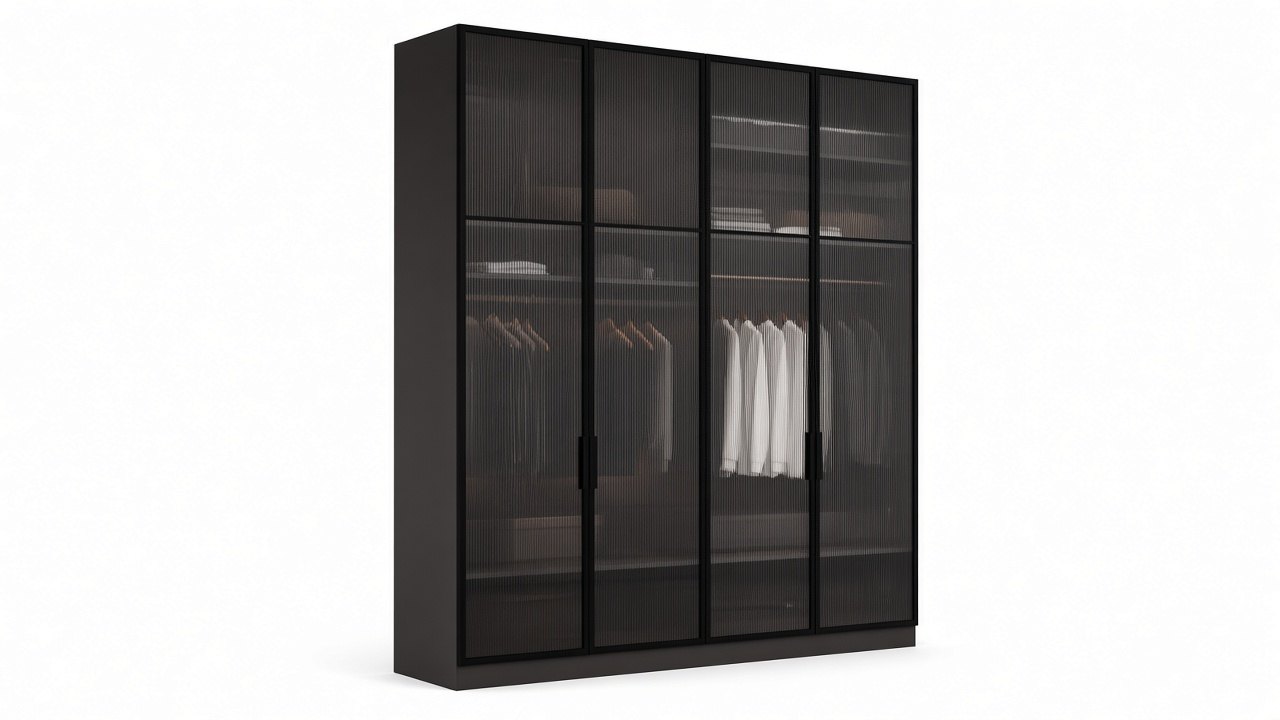
A fifth option, fluted glass: 4–5 mm toughened fluted or tinted fluted glass in an aluminium profile frame. It blurs what is inside while letting light play through. Always insist on toughened glass.
Groove Depth, Pitch and Why Shutters Bow
Every fluted profile is described by a few numbers:
- Pitch: distance from the centre of one groove to the next.
- Groove width: the opening at the face.
- Depth: how far the groove goes into the board.
One Indian design guide suggests, for shutters and drawer fronts seen from 0.6–1.5 m, a pitch of about 12–20 mm and a depth of only 3–4 mm. Deeper 5–6 mm flutes suit walls seen from further away.
Depth matters for strength too. The same guide's working limit is that groove depth in a painted MDF or HDHMR shutter should stay at about one-third of the board thickness or less. So an 18 mm shutter should not be fluted deeper than about 6 mm, and much less if the shutter is tall.
Why fluted shutters warp: one design guide lists flutes cut so deep that 18 mm shutters bow as a common mistake, and notes that tall fluted shutters need balanced finishes on both faces to stay flat. When a fluted door bows even slightly, every stripe shows the fault.
Details That Separate Good Fluting from Tired Fluting
- Plan hardware first. Hinges, push latches and handles should be placed before the flutes are cut. A hinge cup or handle landing in the middle of a groove looks careless.
- Line up the flutes. Where shutters meet, or a shutter meets a drawer front, flutes should continue across the gap. One wardrobe guide suggests the gap between doors should fall inside a groove.
- End properly. A fluted panel should finish against a solid border or a plain strip, never with a half-groove cut off by the edge of the sheet.
- Check light. Side light deepens the shadow in each groove; straight-on light flattens it. Look at a sample on your own wall, morning and evening.
- Do not overdo it. Fluting reads best as a feature. Pairing a fluted centre panel with plain matte or subtle textured shutters keeps the wardrobe calm and easier to clean.
Cleaning and Dust Care
Grooves hold dust; that is the trade-off for the look. Vertical grooves at least let dust fall rather than sit.
- Weekly: run a soft brush, or a vacuum's brush attachment, along each groove from top to bottom.
- Monthly: wipe along the grooves with a barely damp microfibre cloth and a drop of mild soap, then dry at once, especially at the bottom edges.
- Avoid: soaking, harsh chemicals and abrasive pads, especially on MDF and PU. If an edge swells or lifts, get professional advice rather than scrubbing.
What Fluted Shutters Cost (November 2026)
These figures come from published price lists and guides we read in November 2026. Most rates in the Aaditya guide are indicative wall-panel rates from October 2026; shutter quotes add hardware, edge work and fitting.
| Option | Price | Source |
|---|---|---|
| CNC-routed MDF/HDHMR, PU painted | ₹1,000 – ₹1,800 per sq ft installed | Aaditya Interior, Oct 2026 |
| Laminate or membrane-faced fluted MDF | ₹350 – ₹850 per sq ft installed | Aaditya Interior, Oct 2026 |
| Veneered battens or veneered fluted board | ₹600 – ₹1,100 per sq ft installed | Aaditya Interior, Oct 2026 |
| Fluted toughened glass wardrobe shutters | ₹700 – ₹1,400 per sq ft | Aaditya Interior, Oct 2026 |
| Merino 1 mm fluted laminate, 8 × 4 ft sheet | ₹1,886 – ₹2,123 per sheet (sheet only) | Material Depot and Next Level Decor online listings, Nov 2026 |
Prices vary by city, profile, board and finish, so ask for the profile drawing, board grade and finish in writing in every quote.
Quick pick: PU-painted routed MDF or HDHMR for a statement wardrobe in a dry bedroom; fluted laminate strips for budget texture; veneered battens for warmth; fluted toughened glass for lightness.
Frequently Asked Questions
Are fluted wardrobe shutters hard to clean?
They need more care than flat shutters. A soft brush or vacuum brush along the grooves each week, and an occasional damp wipe, is usually enough.
What is the difference between fluted laminate and routed MDF?
Fluted laminate is a thin sheet with shallow pressed ribs glued onto a shutter. Routed MDF has the grooves cut into the board itself, giving deeper, sharper shadows at a higher price.
How deep should the grooves be on a wardrobe shutter?
For shutters seen up close, about 3–4 mm is typical. As a working limit, keep depth to about a third of board thickness, so no more than about 6 mm on an 18 mm shutter.
Will fluted shutters warp?
Tall shutters can bow if grooved too deep or finished on one face only. Shallow grooves, stable boards and balanced finishes on both faces help keep them flat.
Can I use fluted MDF near a bathroom?
Standard MDF is not suited to damp areas. Discuss a moisture-resistant board, sealed edges or a different material for damp walls.
Looking for a wardrobe maker in Raipur? Meet our wardrobe manufacturer team in Raipur.


