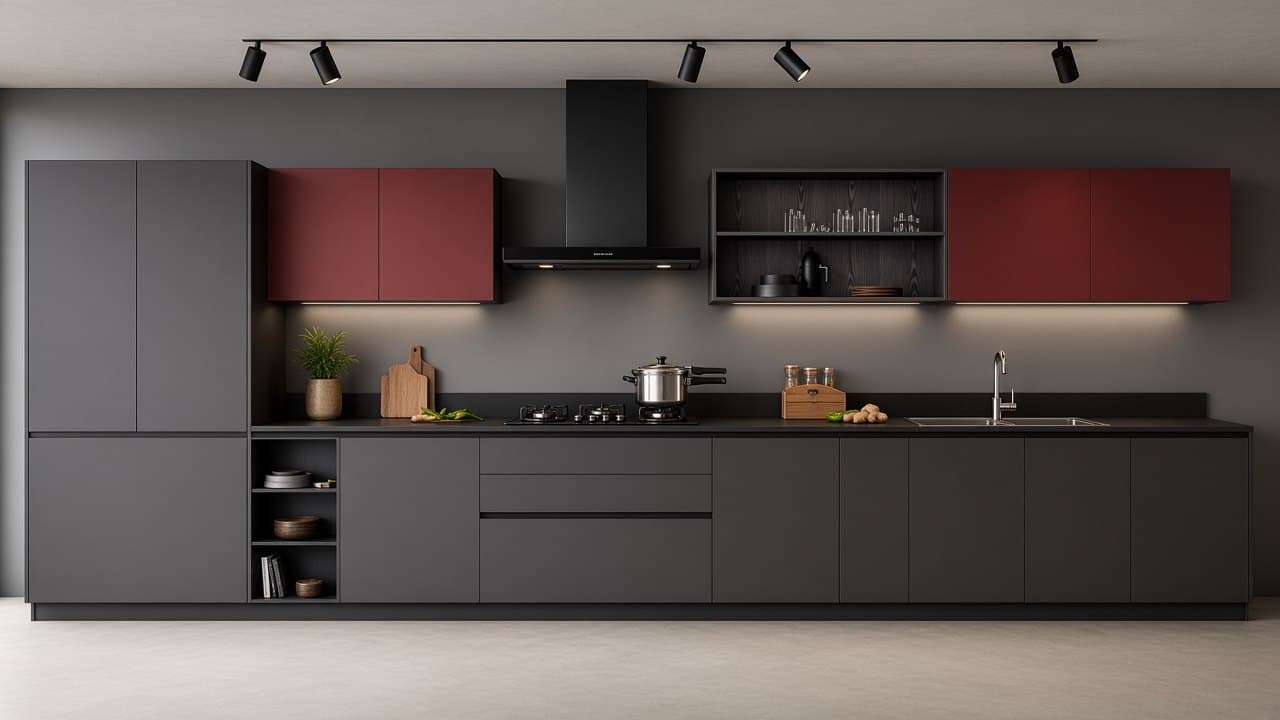
Kitchen Open and Floating Shelves: Board Thickness, Concealed Brackets, Edge Finishes and Load Ratings
How thick should a floating kitchen shelf be, which concealed bracket holds how much, which edge finish lasts, and why your wall type decides the real load.
In this guide 8 sections
A floating shelf looks effortless, but it is a cantilever held only at the wall, and in a kitchen it carries steel dabbas and stacked plates. This guide covers what decides whether it stays straight for years or droops in months.
First, Decide Where Open Shelves Belong
Open shelves are a placement decision before they are a material decision. Asian Paints' Beautiful Homes guide points out that Indian cooking, with high-heat tadka and plenty of steam, puts airborne oil on every exposed surface. It suggests keeping open shelves at least 2 to 3 feet from the hob. Small Kitchen Blog goes further and cites LPG safety guidance from the oil companies: no shelves or storage cabinets above the hot plate. That space belongs to the chimney.
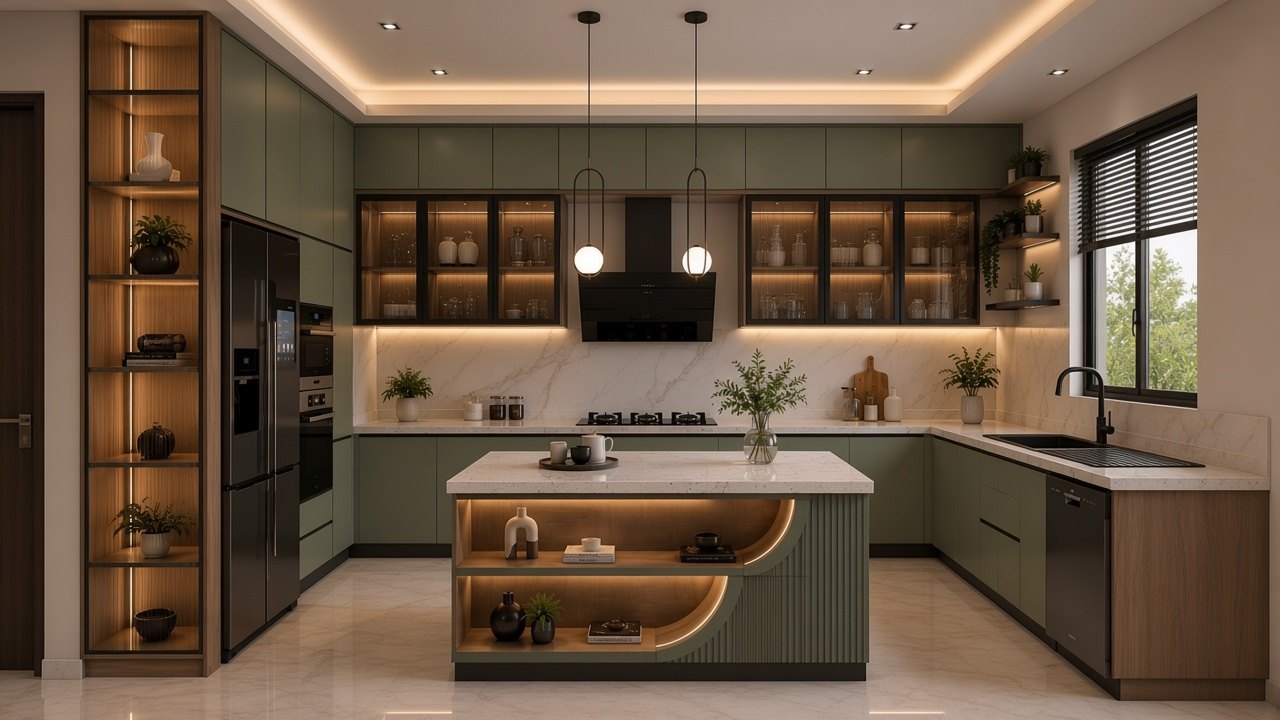
Good spots are above the sink or breakfast counter, at the end of a run, or on an unused corner wall.
Samta Plywood suggests keeping about 20–30% of kitchen storage open and the rest closed. That is enough to keep daily items within reach while bulk storage stays protected from grease and pests.
Depth and Height: Size the Shelf for What Goes on It
Measure what will go on the shelf before you fix a size.
| Contents | Typical depth |
|---|---|
| Spice jars, mugs, small containers | 15–20 cm |
| Everyday plates and bowls | 20–25 cm |
| Dinner plates, platters, canisters | 28–30 cm |
These ranges come from Furnica and Aedifex. Aedifex suggests a starting height of roughly 45–60 cm above the counter for the lowest shelf. It must clear the mixer jar, the tap and the tallest pot you use there.
Depth matters for strength too. Furniture in Fashion explains that nearly every floating shelf fails at the top fixing, which pulls out of the wall. Doubling the depth roughly doubles that pull-out force for the same weight.
Board Thickness: Span Decides More Than You Think
Archid Ply Decor's thickness guide gives a simple rule of thumb for plywood shelves:
| Unsupported span | Suggested thickness |
|---|---|
| Up to 600 mm | 16 mm |
| 600–900 mm | 18 mm |
| Above 900 mm | 25 mm with additional supports |
The concealed bracket sets its own minimum too. A rod has to disappear inside the shelf, and the board needs enough wood around the hole. Häfele's 114 mm rod, as listed by KI Home, needs a shelf at least 24 mm thick. The Italian Triade bracket sold by Dorset suits shelves 30–40 mm thick.
That is why many floating shelves are built thicker than the plywood they start from. Minh Thanh Plywood describes two common methods:
- Solid shelf: two 18 mm layers glued into a 36 mm board and drilled for steel rods. It takes heavier loads.
- Hollow box: a top, bottom and front strip built around a wall cleat. It is lighter and easier to fix level.
Which grade? In a kitchen, use a moisture-proof board. Archid Ply Decor recommends BWP grade for modular kitchens and wet areas. PlyPrice notes that a thicker sheet does not move up a grade: 25 mm BWR is still BWR.
Cost guide: PlyPrice lists branded 25 mm BWP or marine plywood at about ₹185–₹270 per sq ft and branded 25 mm BWR at ₹145–₹245 per sq ft (estimates updated November 2026). Plyneer's own store listed 25 mm sheets at ₹107.80–₹169.10 per sq ft on 3 November 2026. These are board rates only. Brackets, edging, finish and fitting are extra.
Concealed Brackets: Read the Load Rating Carefully
Most floating shelves hang on steel rods that slide into holes drilled in the back of the shelf. The numbers vary widely:
| Bracket (as listed) | Rod length | Rated load |
|---|---|---|
| ADL Components, hardened steel | 73 mm | 20 kg per pair |
| ADL Components, hardened steel | 120 mm | 35 kg per pair |
| ADL Components, hardened steel | 160 mm | 38 kg per pair |
| Triade (Dorset) | — | 30 kg per pair for a 300 mm deep shelf, including shelf weight |
| Häfele 12 mm rod (KI Home) | 114 mm | Up to 40 kg with 2 brackets on a shelf up to 600 mm wide |
Ratings come with conditions. Triade's 30 kg includes the shelf's own weight, and KI Home's figures assume studs or solid backing, not plasterboard. Dorset recommends brackets no more than 400–500 mm apart. KI Home also warns that a wandering drill bit misaligns the shelf, and suggests a bead of adhesive in the holes to stop wobble.
Your Wall Type Sets the Real Limit
A bracket is only as strong as the wall it is fixed to. Tarulo's fixing guide gives indicative pull-out values per correctly installed 8–10 mm anchor:
| Wall | Indicative pull-out per fixing |
|---|---|
| Dense concrete | 5–15 kN |
| Solid clay brick | 1.5–3 kN |
| Hollow or perforated brick | 0.3–1.5 kN |
| AAC (aerated) block | 0.3–1.0 kN |
| Plasterboard alone | 0.1–0.3 kN |
If you are not sure what your wall is made of, ask your builder before drilling. Tarulo warns that AAC looks and drills like solid masonry but crumbles around an ordinary plug. Use purpose-made AAC anchors or a chemical anchor with a mesh sleeve. Fischer, quoted by The Perfect Join, says to drill AAC with rotary action only, with no hammer. For chemical anchors, Tarulo adds that a dusty hole can cost 50–70% of the capacity, so the hole must be blown and brushed clean. In brick walls, Furniture in Fashion advises fixing into the brick face, not the mortar joint.
Edge Finishes: Looks and Stiffness Are Different Jobs
| Edge | What it does |
|---|---|
| ABS or PVC band (0.4–2 mm) | Neat, colour-matched, wipeable. MakeBespoke notes thin gauges chip if struck; a 2 mm eased band suits impact edges |
| Veneer edge | Matches a veneered face, but can scuff through |
| Solid wood lipping | Hides the plies, can be refinished, and can stiffen the shelf |
| Sanded, lacquered ply edge | Shows the layers for a Scandinavian look; needs a well-made, gap-free core |
Bertastore stresses that thin edge banding is a finish, not reinforcement. MakeBespoke's span calculation for an 18 mm board, 300 mm deep, shows why. A flush 20 × 18 mm oak lip at front and back makes it about 1.55 times stiffer. A deep 20 × 40 mm lip, standing below the board like a nosing, makes it about 10.8 times stiffer. Depth beats width every time.
In a kitchen, seal every face, including the underside and the drilled holes. Steam and grease reach all of them.
Keeping Open Shelves Clean
Samta Plywood says open shelves need wiping every week or two. Small Kitchen Blog advises against paper liners near the cooking area, because they soak up oil. A good chimney helps most.
Frequently Asked Questions
How thick should a floating kitchen shelf be?
At least as thick as your concealed bracket needs. That is often 24–40 mm, depending on the system. For plywood spans above 900 mm, Archid Ply Decor suggests 25 mm with extra support.
How much weight can a floating shelf hold?
It depends on the bracket, the depth and the wall. Listed concealed brackets range from about 20 kg to 40 kg per pair, under stated conditions. On AAC block or plasterboard, the wall fixing is usually the weak point.
Can I put open shelves above the hob?
No. Oil company LPG guidance, as cited by Small Kitchen Blog, says there should be no shelves above the hot plate. Keep them at least 2–3 feet away.
Building a new kitchen in Raipur? Explore modular kitchen designs and prices in Raipur.