Modular Wardrobes in Raipur (2026): Sliding vs Hinged, Materials and What Drives the Cost
Compare modular and sliding wardrobes in Raipur: hinged vs sliding doors, BWP, HDHMR and MR carcasses, finishes, and what drives cost — with no price list.
In this guide 7 sections
If you are comparing quotes from a wardrobe manufacturer in Raipur, the useful question is not who has the glossiest 3D render. It is which carcass, door type and finish will still be square, quiet and free of swell after a Raipur summer and a monsoon. Two modular wardrobes can look the same in a drawing and be built very differently.
This guide walks through why the local climate matters, how sliding and hinged doors compare, what BWP plywood, HDHMR and MR boards actually are, which shutter finishes are commonly specified, and how interior planning and specification drive the cost. There is no single wardrobe price list that fits every bedroom, so the sections below focus on the choices that move a quotation — not on a headline rate.
Why Raipur Homes Need Moisture- and Termite-Safe Wardrobes
Raipur's year has two very different indoor climates, and a wardrobe has to live through both.
India Meteorological Department 1991–2020 normals for Raipur, as published in the city's climate table (which cites IMD's Climatological Tables 1991–2020), show a hot, relatively dry summer and a humid monsoon. The mean daily maximum in May is 41.8°C, and afternoon relative humidity at 17:30 IST falls to 24% in April and 26% in May. From June the picture reverses: July and August afternoon humidity rises to 76% and 79%, July's average rainfall is 377.4 mm, and the year as a whole averages 1,290.3 mm, most of it in the southwest monsoon. IMD's Meteorological Centre in Raipur notes that the monsoon normally withdraws in the first or second week of October, when humidity is still around 77% to 62%.
That swing matters inside a closed cabinet. Summer heat dries the room; the monsoon then loads humid air into lofts, back panels and the gap against an external wall. A board that only just copes with ordinary indoor moisture can swell, stain or loosen screws after a few wet seasons, especially if the wardrobe sits on a damp wall or beside a bathroom.
Termites add a second reason to be careful. Duroply notes that termites thrive in warm, humid environments and feed on cellulose in wood products such as plywood, and that moisture is one of the main factors that attract them. A plywood grade (MR, BWR or BWP) describes water resistance. It is not, by itself, a termite treatment. Ask for factory-treated, branded boards, get that treatment in writing, and keep the wardrobe dry: fix leaks, seal edges, and do not treat a damp wall as a problem the carcass can solve on its own.
Sliding vs Hinged: Room Size, Clearance and Cost Drivers
The first design decision is how the shutters open. A sliding versus hinged wardrobe comparison is really a room-planning question, not only a style question.
Hinged (openable) shutters swing out on hinges fixed to the side panels. When both doors are open you see the full interior, which makes drawers, trouser pull-outs and lofts easier to place. The trade-off is floor space: you need a clear swing in front of the wardrobe. In a compact bedroom where the bed sits close to the wardrobe wall, that clearance is often the deciding factor.
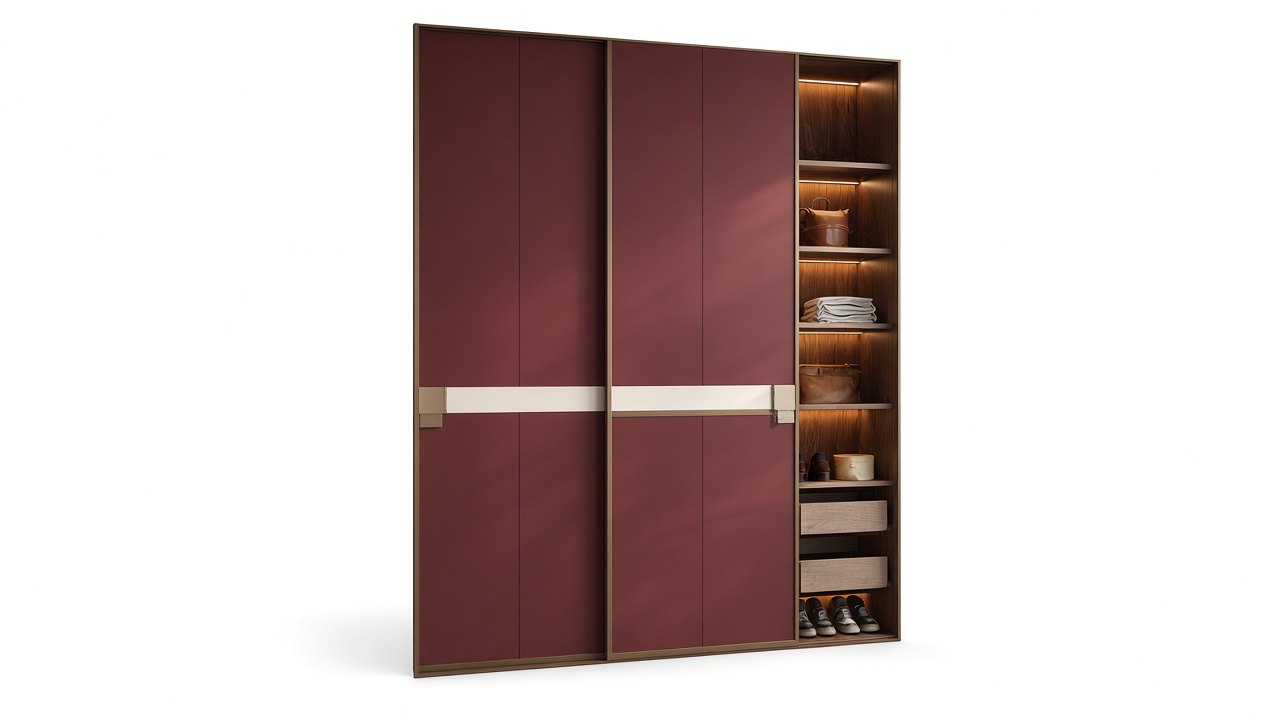
Sliding shutters glide on a track, so they need no swing space. That is why a sliding wardrobe is often the practical choice in a tight room. The trade-offs sit elsewhere: one leaf usually covers part of the interior, so you see roughly half at a time, and internal drawers have to be planned so they clear the overlapping shutters. The track also has to be fitted accurately; a sliding system depends on rollers, alignment and, preferably, soft-close and anti-jump hardware.
What drives the cost (with no rupee figures). Sliding hardware — the track, rollers and dampers — is a more complex system than a set of hinges, and the shutters themselves are often larger and heavier, so a sliding wardrobe typically sits higher in a quotation than a hinged one of the same size and finish. Other cost drivers, for either door type, are:
- overall width and height, including loft shutters
- carcass grade and thickness
- shutter finish (laminate, acrylic, PU, glass or fluted)
- named hardware and internals (drawers, pull-outs, lighting)
- how square and level the wall and floor are, which affects fitting time
Room size and clearance should decide the door type. Finish and hardware then decide how that door is specified. A useful quote names both.
Carcass Materials: BWP Plywood vs HDHMR vs MR
The carcass is the box you stop seeing once the shutters are on, which is why it is the easiest place for a quote to look vague. Our guide to the best wardrobe materials in India — MR, BWR, BWP and HDHMR sets out the same choice in more detail. The short version for a Raipur bedroom is below.
MR plywood is moisture-resistant, not waterproof. The BIS product manual for IS 303:2024 lists MR, BWR and BWP as the three grades of general-purpose plywood. CenturyPly describes MR as an interior-grade board, typically bonded with urea-formaldehyde resin, and suggests it for closets and wardrobes in dry rooms. In a well-ventilated, air-conditioned bedroom away from wet walls, MR can be a reasonable everyday board. In a monsoon-humid room, against an external wall, or beside a bathroom, it is a tighter choice.
BWP plywood is the boiling-water-proof grade, and it is the carcass Make My Space uses for standard wardrobes. Under the 2024 Indian standards, "BWP" is not automatically the same thing as marine plywood: IS 303:2024 includes a BWP grade for general-purpose plywood, while IS 710:2024 is a separate standard for marine plywood, which must be bonded with a BWP-type adhesive conforming to IS 848. CenturyPly, writing before that revision, still maps BWP to IS 710 and positions it for water-prone furniture. For a wardrobe quote, ask for the grade and the IS/BIS standard in writing, and check the marks when the material arrives.
HDHMR is high-density, high-moisture-resistance fibreboard, not plywood. Action TESA, which holds the HDHMR trademark, states a density of over 850 kg/m³ and lists resistance to moisture, borers, termites and fungus among the board's properties. It names wardrobes as a typical use, and links that density to screw- and hinge-holding and to shelves that sag less under a sustained load. The same manufacturer is clear that HDHMR is highly moisture-resistant, not completely waterproof: prolonged standing water can still swell the fibres. A quote should name the product, not only the letters "HDHMR".
For most Raipur bedrooms, the practical comparison is a moisture-grade plywood carcass versus a named HDHMR board, with edges sealed in either case. Make My Space standard wardrobes are built on a BWP plywood carcass.
Shutter Finishes: Laminate, Acrylic, PU, Glass, Fluted
The shutters are what you see and wipe every day, and they are a visible part of the budget.
- Laminate is the workhorse: a wide range of colours and textures, including woodgrains, and a practical face for daily use. Edges should be banded properly, because that is where moisture and knocks show first.
- Acrylic gives a deep gloss and can make a smaller bedroom feel brighter. It typically sits above laminate in a quotation, and dark gloss shows fingerprints until you wipe it.
- PU is a sprayed, colour-matched paint finish. It can look seamless, and it usually sits at the premium end. As a paint film, it needs care against knocks at the edges.
- Glass — clear, tinted, fluted or back-painted, often in an aluminium profile — changes the look of the room and the weight of the shutter. Glass leaves need the right hardware, especially on a sliding track, and a chipped panel is usually replaced, not patched.
- Fluted or ribbed shutters add a vertical texture, whether the grooves are routed in the board, formed in a profiled laminate, or built from slats. They hide fingerprints better than a flat gloss, and they need a core that routes cleanly and edges that are finished well.
The quote should name the finish, the board underneath, and the edge detail — not just "premium shutters". Mixing finishes (for example, laminate on most leaves and a glass or fluted centre) is common, as long as each leaf is specified.
Interior Planning: Lofts, Drawers, Hanging, Lighting
A well-chosen carcass and finish still disappoint if the inside is an afterthought. Plan the interior on the same drawing you approve, before production starts.
- Hanging. Short-hang for shirts, longer hanging for kurtas and dresses, and enough clear width so garments are not crushed. The hanging rail and its supports should be named, and the load should match how the bay will actually be used.
- Drawers and pull-outs. Drawers work well for folded clothes, inner wear and accessories; trouser and tie pull-outs only help if the carcass is deep enough and, on a sliding wardrobe, if they clear the overlapping shutter.
- Shelves and lofts. Shelves take folded stacks and bags; lofts take luggage and seasonal bedding. Loft shutters should be easy to open at your ceiling height, and the loft should be in the quote if it is in the drawing.
- Lighting. LED profiles and door sensors are much easier to install when the channels and power point are planned with the carcass, not added after the backs are fixed.
If an accessory appears in the 3D view, it should appear as a line item.
How Make My Space Builds Wardrobes
Make My Space takes responsibility for the specification, the checks and the installation. Standard wardrobes are built on a BWP plywood carcass. Projects are completed in 45 days and are backed by a 10-year warranty. Get the start date, what "completion" includes, and the warranty coverage in writing, as you would with any firm.
Visit the Make My Space showroom at 3rd Floor, Isha Enclave, opp. Magneto Mall, Vishal Nagar, Raipur 492006, open 11 AM–8 PM, or call +91 75838 37711.
Frequently Asked Questions
What should I look for in a wardrobe manufacturer in Raipur?
Ask for the carcass grade and IS/BIS standard in writing, named hardware, an itemised interior (including lofts and lighting), a written timeline and warranty, and a showroom where you can open a shutter and look at a carcass sample. A render alone is not a specification.
Is a sliding wardrobe better than a hinged one in a small Raipur bedroom?
Sliding is often the better fit when the bed or a wall leaves too little swing space for hinged doors. If the room has the clearance, hinged shutters are simpler, give full access to the interior, and usually sit lower in a quotation for the same size and finish.
Which carcass material is best for a wardrobe in Raipur?
It depends on the room. MR plywood is an interior, moisture-resistant grade that manufacturers such as CenturyPly suggest for dry-room closets. BWP is the higher, boiling-water-proof plywood grade, and it is the carcass Make My Space uses for standard wardrobes. HDHMR is a dense, moisture-resistant fibreboard, not a waterproof one. For monsoon humidity or a wall that can get damp, specify a moisture-grade board and sealed edges, and ask for factory termite treatment separately from the grade name.
Why is there no single wardrobe price for Raipur?
Because size, sliding or hinged doors, carcass grade, shutter finish, hardware and internals all change the total. A useful quote is itemised for your wardrobe, not copied from a generic list. Make My Space does not publish a starting price for wardrobes.
How long does a Make My Space wardrobe take, and what warranty do I get?
Projects are completed in 45 days and are backed by a 10-year warranty. Ask for both in writing, including the start point and what the warranty covers.
Planning a wardrobe in Raipur? See our modular wardrobes in Raipur.


