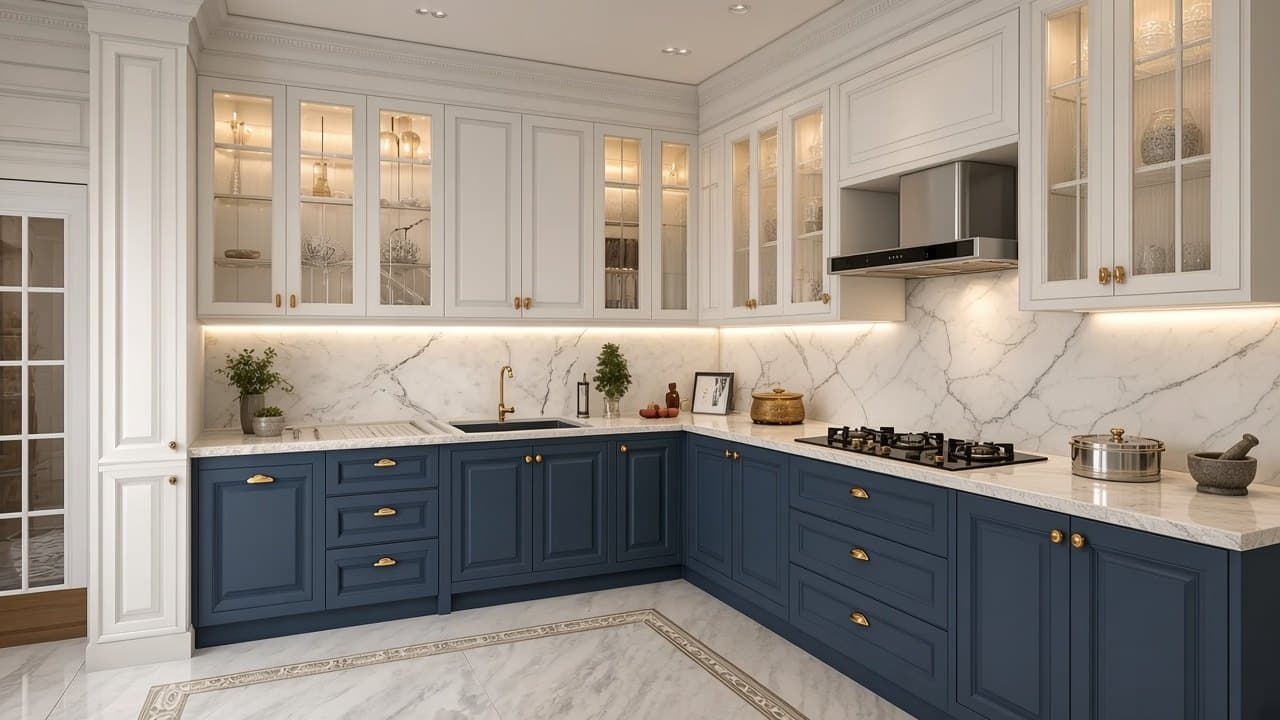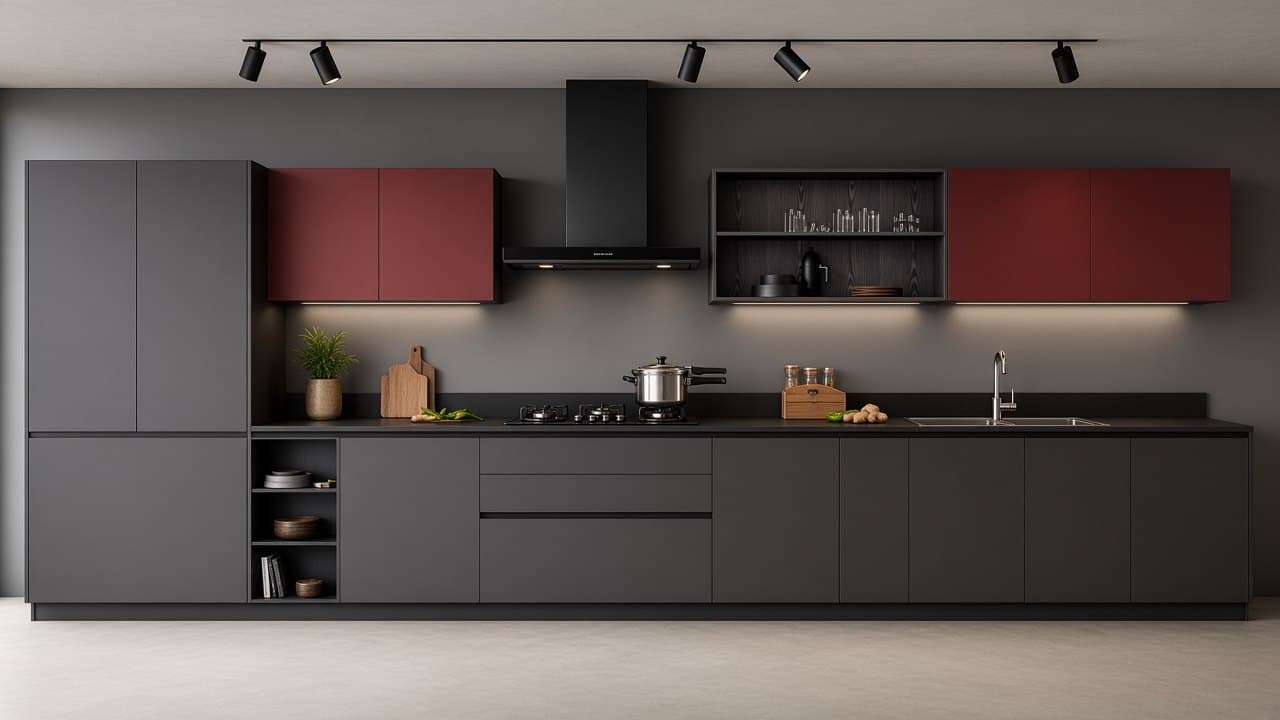
Shutter Core Materials: Plywood, HDHMR, MDF and Aluminium-Framed Shutters Compared
Plywood, HDHMR, MDF or aluminium-framed glass? How the board inside a kitchen or wardrobe shutter decides flatness, hinge grip and water resistance, with 2026 rates.
In this guide 10 sections
Shutter conversations usually start with the finish: laminate or acrylic, matte or gloss. But a finish is only a thin skin. Underneath is the core, the board that decides whether the shutter stays flat, holds its hinges and survives water at the edges.
This guide compares the four cores you will see on Indian kitchen and wardrobe quotes: plywood, HDHMR, MDF and aluminium frames holding glass or other panels.
What a Shutter Has to Do
A shutter carries no load; its one structural task is to stay flat and swing true for years while hung from one edge, opened many times a day with wet hands, often beside the sink or hob. So the core needs flatness, screw holding for hinges that get adjusted, and moisture tolerance at the cut edges. No single board wins on all three, which is why good kitchens often mix cores by zone.
Plywood Shutters
Plywood is made of thin wood veneers glued with the grain of each layer at right angles to the next. That cross-grain build makes it strong, relatively light, and the best of the boards at gripping screws, including screws that are removed and driven again. In BWP grade, its waterproof bond also makes it the most water-tolerant board, which is why it is the safer core under and around the sink.
Its weakness as a shutter is flatness. Interior firms point out that plywood's veneers carry internal stresses, so a tall shutter can develop a gentle wave over time, and its grain can show through thin gloss finishes.
The fix is quality and detailing: branded, calibrated, gap-free plywood laminated on both faces, with enough hinges for the height.
HDHMR Shutters
HDHMR (high-density, high-moisture-resistant board) is made from fine wood fibre pressed with moisture-resistant resin to a high density, typically listed at about 850 kg/m³ or more. Because it has no grain and no layers, it is uniform in every direction.
That makes it very good at the shutter's main job. It stays flat, takes laminate, acrylic, membrane and PU finishes cleanly, and machines crisp edges for handleless designs. It holds hinge screws well, though plywood does better when screws are re-driven many times.
Two cautions: HDHMR is heavy, so tall shutters may need an extra hinge, and it is water-resistant, not waterproof, so cut edges and hinge holes must be sealed.
MDF Shutters
MDF (medium-density fibreboard) is the smoothest and most machinable core. It is the natural base for PU-painted shutters, shaker-style frames and membrane (PVC foil) shutters with routed patterns, because the foil is vacuum-pressed over the surface and any grain or void would show.
Its weakness is water. Standard MDF swells if water reaches a cut edge, and it holds screws less well when hinges are adjusted repeatedly. In practice, MDF shutters belong in dry zones such as wall units, tall units and wardrobes, with every edge sealed.
Aluminium-Framed Shutters
An aluminium profile shutter is a different system altogether: an extruded aluminium frame, mitred at the corners, holding a panel of glass, mirror or sometimes a solid infill. There is no board core to swell, and the metal border protects the panel edge from chipping.
They suit crockery and display units, and wardrobe doors in mirror or bronzed glass.
What to check:
- Glass type and thickness. Profile catalogues commonly list 4 mm or 5 mm glass; ask for toughened glass and confirm the profile is made for that thickness.
- Door weight. Glass weighs about 2.5 kg per square metre for every millimetre of thickness, so a 600 × 2,000 mm door in 4 mm glass carries about 12 kg of glass before the frame.
- Hinges. Narrow frames need hinges made for aluminium profiles; standard board hinges do not fit.
- Frame width. One Indian supplier's catalogue lists its slim 20 mm frame for shutters up to 600 × 1,200 mm (wall units), and its 45 mm frame for tall wardrobe doors up to 600 × 3,000 mm.
Side-by-Side Comparison
| Core | Flatness | Screw holding | Water tolerance | Best for |
|---|---|---|---|---|
| BWP plywood | Good if calibrated and balanced | Best | Best of the boards | Sink base, dishwasher side, damp walls |
| HDHMR | Very good | Good | Good, edges sealed | Flat, handleless and gloss shutters; tall doors |
| MDF | Very good | Fair | Poor to fair | Painted, membrane and routed shutters in dry zones |
| Aluminium frame | Very good | Uses profile hinges | Frame does not swell | Glass display units, mirror wardrobes |
What the Boards Cost (Dated Prices)
These are dealer counter rates we read for 18 mm raw board, per sq ft, excluding GST. The finished shutter costs more once the finish, edge band and labour are added.
| 18 mm board | Price range | Source date |
|---|---|---|
| BWP plywood, Century range (Sainik 710 to Club Prime), Ahmedabad dealer | ₹116–₹154 per sq ft | as of August 2026 |
| HDHMR / HDMR (Action Tesa HDHMR, Greenply HDMR), Ahmedabad dealer | ₹107–₹110 per sq ft | as of August 2026 |
| Interior MDF (Action Tesa, Greenply), Ahmedabad dealer | ₹62–₹66 per sq ft | as of August 2026 |
| Exterior-grade MDF (Action Tesa, Greenply), Ahmedabad dealer | ₹79–₹84 per sq ft | as of August 2026 |
| Glass in aluminium profile, finished shutter, interior firm's indicative rate | about ₹700–₹1,400 per sq ft | October 2026 |
Rates vary by city; ask for brand and grade in writing.
Details That Matter More Than the Board
Good cores still fail with poor detailing:
- Balance both faces. Laminate on the front only makes the shutter cup as the bare back absorbs moisture. Use a balancing laminate or liner on the inside.
- Seal every edge. Machine-applied edge band on all four edges, about 2 mm on visible shutter edges. Most swelling starts at a lifted bottom edge.
- Use 18 mm for full-height work. Thinner boards suit only small cabinets.
- Enough hinges. A Delhi dealer's rule of thumb: 2 hinges up to 3 ft, 3 up to 5 ft, 4 up to 6.5 ft, and more for heavy shutters.
- Split very tall doors. For a 7 ft wardrobe, a main shutter plus a separate loft shutter stays flatter than one long door.
How Make My Space Approaches It
At Make My Space, we write the shutter core and the finish as separate lines in your specification, so you know exactly what sits behind the laminate or acrylic. Our kitchens and wardrobes are built on a BWP plywood carcass, with a premium aluminium kitchen option where you want it. Modular kitchens start from ₹3.5 lakh and full home interiors start from ₹10 lakh, are completed in 45 days and come with a 10-year warranty.
FAQ
Is HDHMR better than plywood for shutters?
For flat, handleless and gloss shutters, HDHMR usually stays flatter because it has no grain. Plywood holds screws better and, in BWP grade, handles water better, so it is the safer core at the sink.
Can MDF be used for kitchen shutters?
Yes, for painted, membrane and routed designs in dry zones such as wall and tall units. Keep it away from the sink and dishwasher, and seal every edge.
Why do shutters bend?
Most often because of laminate on one side only, a board that is too thin, moisture through open edges or too few hinges.
Are aluminium-framed glass shutters strong enough for daily use?
Yes, with toughened glass, a profile rated for the glass thickness and hinges made for that profile. Check the door weight before choosing hinges.
Should all shutters use the same core?
Not necessarily. The finish can match throughout while the core changes by zone, such as BWP plywood at the sink.
Planning a kitchen in Raipur? See our modular kitchens in Raipur.