
Wardrobe Lighting: LED Profiles, Sensors and Drivers Explained
LED profiles, door sensors, 12V vs 24V drivers, CRI and colour temperature: how to plan wardrobe lighting that shows true colours, with October 2026 costs.
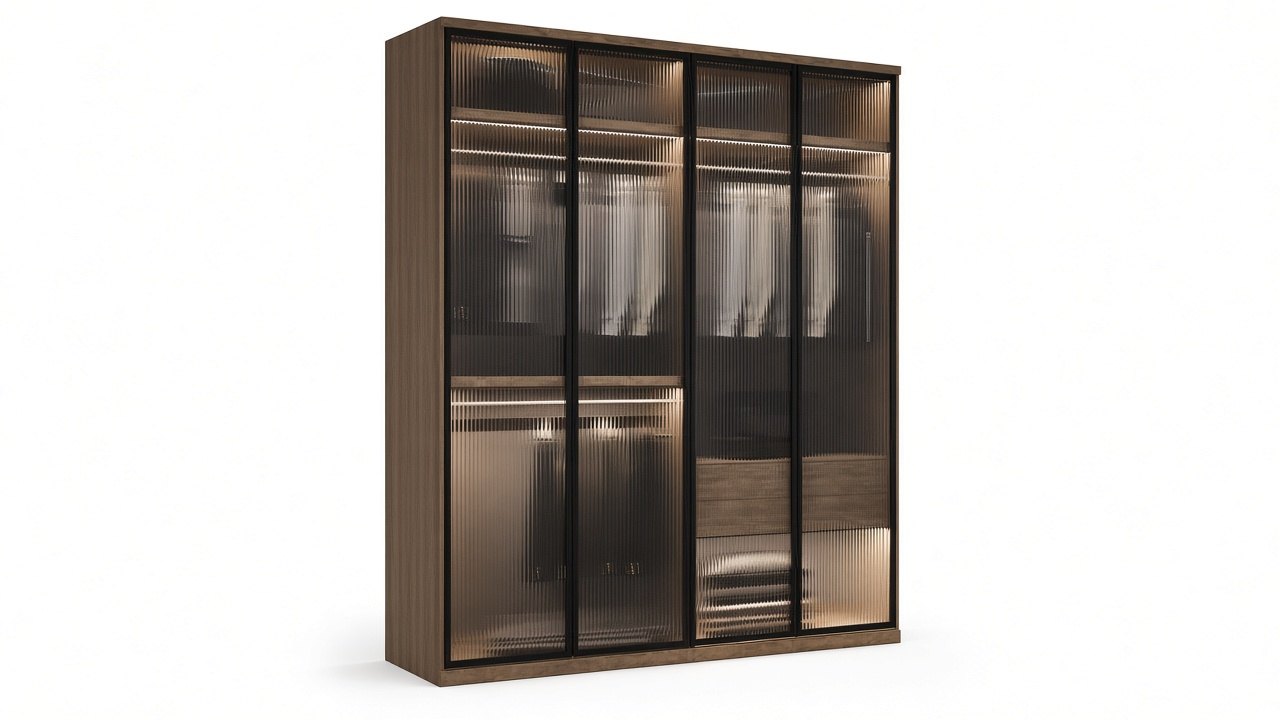
In this guide 8 sections
Most wardrobes in Indian bedrooms are lit by the ceiling light behind you. That means your own shadow falls straight into the shelves, the back corners stay dark, and the navy shirt you pick turns out to be black once you step outside.
Wardrobe lighting fixes this, but it is a small electrical system, not just a strip of tape. A good one has four parts working together: the LED strip, the aluminium profile it sits in, the sensor that switches it, and the driver that powers it. Get any one wrong and you end up with visible dots, flickering, lights that do not switch on, or a strip that dims within a couple of years.
Here is how each part works, what to ask for, and what it costs.
The Four Parts of a Wardrobe Light
| Part | What it does | What to ask for |
|---|---|---|
| LED strip | Produces the light | CRI 90+, 3500–4000K, 12V or 24V to match the driver |
| Aluminium profile with diffuser | Holds the strip, spreads light evenly, draws away heat | Recessed or surface profile with opal diffuser |
| Sensor | Switches light on when the shutter opens | Door (reed or IR) sensor for hinged shutters, PIR for walk-ins |
| Driver | Converts 230V mains to low-voltage DC | Sized for total wattage plus a safety margin, placed where it can be reached |
LED Profiles: Why the Strip Should Never Sit on Bare Wood
An LED profile is an extruded aluminium channel with a diffuser on top, usually silicone, polycarbonate (PC) or acrylic (PMMA). The strip is pressed into the channel and the diffuser clips over it.
The profile does two jobs. First, it hides the individual LED dots. A bare strip shows as a row of bright points, and on glossy shutters, lacquered shelves or glass they reflect as a dotted line. A diffuser turns them into one continuous line of light.
Second, it handles heat. LEDs produce heat at the chip. Plywood and MDF are insulators, so a strip stuck straight onto a shelf traps that heat, which speeds up dimming and colour shift. Aluminium carries the heat away. Hardware makers such as Häfele specify that their strips should only be used with an aluminium profile or cooling strip, never fixed directly on wood.
Profiles come in a few shapes:
- Recessed profiles sit in a groove routed into the shelf or side panel, flush with the surface. They look the cleanest but must be planned before the panels are cut.
- Surface profiles are screwed or clipped onto the panel. They are easier to add later but stand slightly proud.
- Corner profiles fit at 45 degrees in the corner between the side panel and top, washing light down across the hanging space.
- Hanging-rod lights combine a wardrobe rail with a built-in light, so clothes are lit from just above.
Colour Temperature and CRI: The Settings That Matter Most
Two numbers decide whether your clothes look right.
Colour temperature (CCT) is measured in kelvin. 2700–3000K is warm and cosy but can distort blues and whites. 5000K and above is cool and harsh for a bedroom. For wardrobes, 3500–4000K, often called neutral white, is the usual recommendation because fabrics look the way they do in daylight.
CRI (Colour Rendering Index) measures how accurately a light shows colours on a 0–100 scale. Lighting guides note that generic strips sold in local electrical markets often sit around CRI 70–80, which makes navy look black and brown look grey. For wardrobes, ask for CRI 90 or higher. This matters more than raw brightness.
Sensors: Matching the Switch to the Shutter
The sensor is what makes wardrobe lighting feel effortless. There are four common types:
- Door contact (magnetic reed) sensors switch the light when the shutter opens or closes. They are the most predictable choice for hinged wardrobes, and installers often find them more reliable over time than motion sensors.
- Infrared door sensors detect the shutter at a short distance. They are compact and work well on single shutters and drawers, though very dark or glossy surfaces can affect the sensing distance.
- PIR motion sensors detect body heat. They suit walk-in closets and open dressing areas where the sensor has a clear view. Inside a closed wardrobe, hanging clothes can block them and slow hand movements may not trigger them.
- Touch sensors let you switch or dim manually by touching a pad. They suit display units or people who want control.
For sliding wardrobes, plan the sensor position carefully, because each shutter covers a different section as it moves. Many homeowners choose one sensor per section or a PIR sensor at the top.
Drivers: The Part Nobody Thinks About Until It Fails
LED strips run on low-voltage DC, usually 12V or 24V. The driver converts household mains into that voltage. A few rules keep it reliable:
- Size it with headroom. Add up the wattage of every strip on the driver and choose a driver rated about 15–25% higher. A driver run at its limit runs hot and fails early.
- Pick 12V or 24V deliberately. 12V suits short shelf and cabinet runs. 24V carries less current for the same power, so it suffers less voltage drop over longer runs, which helps avoid one end of a long wardrobe being dimmer than the other.
- Choose a good-quality driver. Driver quality decides flicker, dimming compatibility and safety. Cheap drivers are a common source of buzzing and flicker.
- Keep it accessible. Place the driver in a loft, a ventilated cavity or a removable panel, not sealed behind a fixed board. Drivers are the part most likely to need replacing.
Ask your electrician to provide a dedicated point near the wardrobe at the planning stage, so you do not end up with a visible extension cord.
What It Costs (Checked October 2026)
Prices vary widely with brand, length and how much of the wardrobe is lit. These figures were listed by Indian retailers and lighting guides when checked in October 2026:
| Item or setup | Price range (Oct 2026) |
|---|---|
| Wardrobe and cabinet door sensors (12V/24V) | ₹200–₹550 each |
| Recessed or surface PIR motion sensor | ₹750–₹850 each |
| IKEA ÖVERSIDAN sensor strip, 71 cm, plus its separate driver | ₹1,450 plus ₹1,300 |
| Basic sensor strip for one hanging section | ₹3,000–₹8,000 |
| Lighting for one wardrobe (strips and sensors) | ₹5,000–₹20,000 |
| Premium wardrobe with recessed, drawer and sensor lighting | ₹20,000–₹40,000 |
The biggest cost drivers are the number of lit sections, recessed versus surface mounting, and the quality of the strip and driver.
How Make My Space Approaches It
At Make My Space, wardrobe lighting is planned with the wardrobe layout, not added after installation. Profile grooves, cable paths and driver locations are marked in the design so the light sits flush and the wiring stays hidden. Our standard wardrobes use a BWP plywood carcass; modular kitchens start from ₹3.5 lakh and full home interiors start from ₹10 lakh, delivered in 45 days and backed by a 10-year warranty.
FAQ
What colour light is best inside a wardrobe?
Neutral white, around 3500–4000K, with a CRI of 90 or higher. It shows fabric colours close to daylight.
Which sensor is best for a hinged wardrobe?
A door contact (magnetic reed) sensor or an infrared door sensor. They switch reliably as the shutter opens. PIR motion sensors are better for walk-in closets.
Should I choose a 12V or 24V LED strip?
12V is fine for short shelf runs. For long continuous runs, 24V reduces voltage drop, so the light stays even from end to end.
Can wardrobe lights be added to an existing wardrobe?
Yes, with surface profiles, battery or USB sensor lights, or rod lights. Recessed profiles and hidden wiring are much easier when planned before manufacturing.
Do wardrobe LED lights get hot?
The strip produces some heat, which is why it should sit in an aluminium profile. Properly installed, the light stays cool enough to sit near clothes.
Planning a wardrobe in Raipur? See our modular wardrobes in Raipur.


