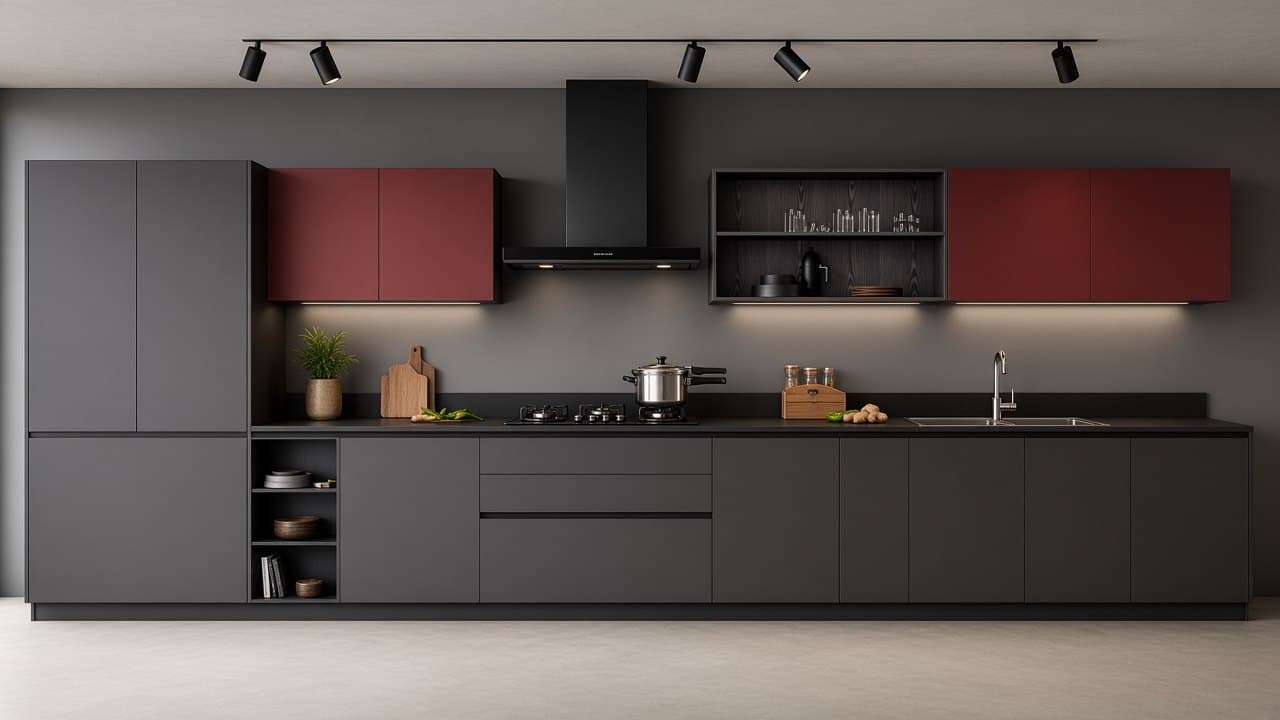
Kitchen Shutter Edge Profiles: Square, Bevelled, J-Profile and G-Profile Handle-Less Edges
Square, 45° bevelled, routed J-pull or aluminium G/J profile? How each kitchen shutter edge is made, how it grips, cleans and lasts, and where gola fits.
In this guide 9 sections
You choose a shutter by its face, but your hand touches its edge hundreds of times a week. The edge decides how the shutter is gripped and how well its core is sealed against steam.
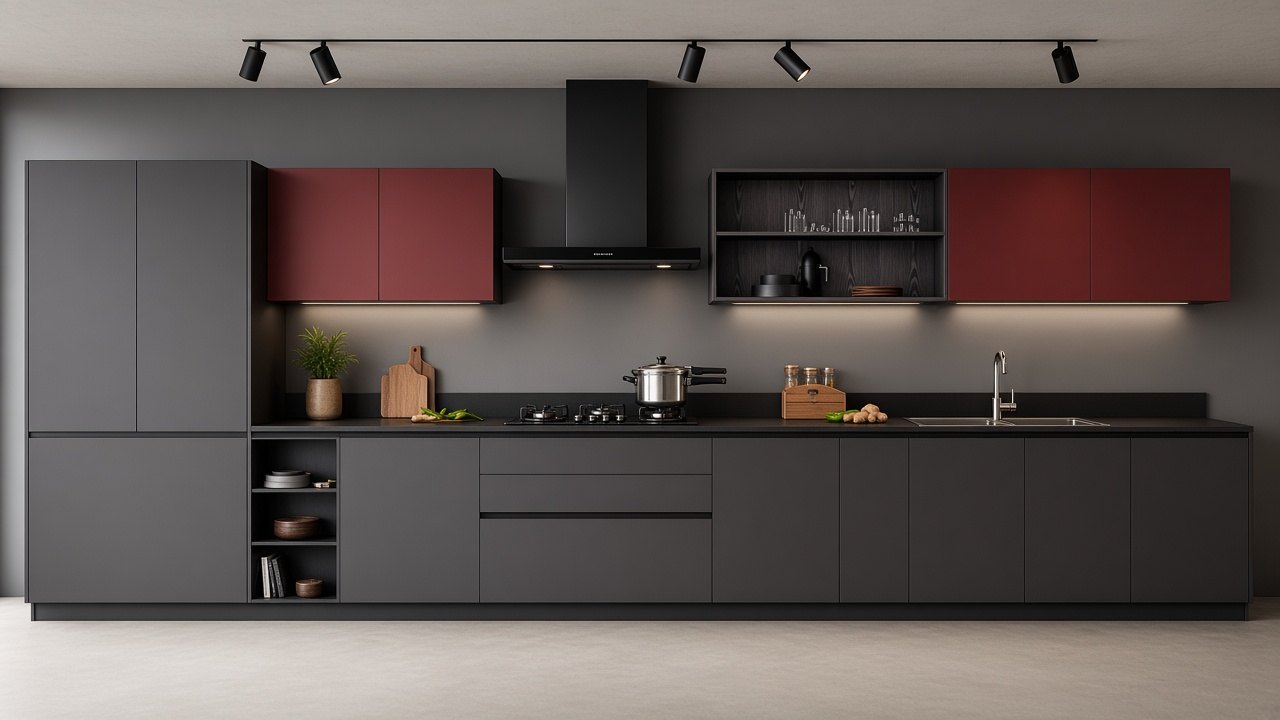
"Handle-less" is not one product. A 45° bevel, a routed groove, an aluminium J or G profile and a gola channel can look alike in a photo, but they are built and behave differently.
Why the Edge Matters More Than It Looks
A cut edge exposes the board's core. WoodAge's edge-banding guide explains that moisture and steam wick into an unsealed edge, the core swells, and the face finish can lift. So the edge's first job is to seal the board; its second is to give your fingers something to hold.
1. Square Edge With Edge Banding
How it is made: The shutter is cut square and a strip of PVC, ABS or acrylic edge band is glued to all four edges by machine, then trimmed flush.
What to specify: WoodAge recommends 2 mm banding on shutters and drawer faces, and 2 mm with PUR adhesive for sink, hob and dishwasher units. Standard hot-melt EVA glue, it notes, softens with heat and degrades with moisture. REHAU, a major edge-band maker in India, says its zero-joint edgebands use a pre-applied polymer layer in place of glue, giving an invisible joint with a heat- and moisture-resistant bond.
Grip: None; it needs a handle or push-to-open hardware.
Finishes: Works with laminate, acrylic and membrane shutters if the band matches the face; REHAU India offers mirror-gloss (over 85 gloss points) and supermatt (below 4) bands.
Check it yourself: WoodAge's signs of a good job: no ridge or step, a hairline glue line at most, tight corners and an exact colour match.
2. Bevelled (45°) Edge, or "Sharknose" Finger Pull
How it is made: A 45° bevel is cut along the top edge of a base shutter, or the bottom edge of a wall shutter, so your fingertips can catch the back of the door. Machinery maker BESTIN describes the process: mill the bevel, apply EVA or PUR adhesive, press the edge band on, then trim and buff. It works on MDF, plywood and particle board.
Grip: Fingertip only. Aaditya Interior notes that routed grips are usually shallower than a G profile, so they suit lighter shutters better than heavy drawers.
Durability: A sharp point is the weak spot. The European Panel Federation's MDF guidance says sharp edges should be slightly rounded so paint or lacquer covers them well and resists knocks.
Finishes: Cabinet maker Little Giants notes the bevel reads as a fine shadow line on pale melamine but a hard highlight on gloss acrylic. See a sample first.
3. Routed J-Pull or Recessed Groove (No Metal)
How it is made: A CNC machine cuts a J-shaped groove or curved recess into the shutter itself. Aaditya Interior says this suits painted MDF, PU and acrylic-faced boards whose cut edge can be finished to match the face. On laminated boards the cut exposes the core, which then has to be edge-banded or painted.
Grip and cleaning: Fair grip. Aaditya warns grooves fill with grease and their edges wear, so painted grooves may need touch-ups.
Watch the naming: WoodAge notes that a "J-profile" on one quote may be a metal profile and on another a groove cut into the board. Ask for a cross-section and product code.
4. Aluminium J, G and C Edge Profiles
How they are made: An extruded aluminium section is fixed into the routed edge of the shutter. Mirano describes its J profiles as having a rounded finger channel on the front and a ribbed stem that fits into the panel edge. One extrusion forms the handle and caps the raw board edge at the same time. Mirano's Eureka J comes in 3 m lengths for 18 mm panels, with 45° corner connectors and end caps.
The G profile has a squarer groove and lip. Hettich India lists its Eslinga G profiles in 35 mm and 40 mm heights. Häfele lists a J-shape cabinet-wide handle that is 30 mm wide and 19.5 mm deep, in satin or matte aluminium.
Grip: Good. Aaditya Interior says G profiles give a continuous 20–30 mm finger grip usable with any part of the hand, and are India's most widely used handle-less system. They go on the top edge of base units and bottom edge of wall units.
Durability: Well-machined profiles last for years; Aaditya says failures usually come from inaccurate routing, causing rattles, gaps or a lifting end.
Cleaning: Grease and dust settle in the channel, so wipe base-unit profiles weekly.
Finishes: Because the metal caps the edge, a profile can be used across most shutter finishes. Mirano offers ten finishes, from silver and champagne to black and rose gold.
5. Where Gola (Channel) Handle-Less Fits
A gola system moves the grip off the shutter and into the cabinet. Hettich India makes an L-type profile (56.9 mm high) that runs under the worktop and a C-type profile (73.5 mm high) that runs between drawer rows. There are also vertical L and C profiles for tall units. The fronts stop short of the channel and leave a shadow-line recess.
What to know before choosing gola:
- Plan it at carcass stage. Gola is built into the carcass, so it is hard to add later. WoodAge reminds buyers that each profile takes height from the fronts around it.
- Clean the recess. Aaditya notes crumbs collect there; wipe weekly and brush the corners.
- Test a sample. WoodAge suggests trying a loaded drawer, wet hands and fingernail clearance before approving.
Quick Comparison
| Edge | How it is made | Grip | Cleaning | Best finishes |
|---|---|---|---|---|
| Square, banded | 2 mm edge band, ideally PUR or zero-joint | Needs a handle | Easiest | All |
| 45° bevel | Milled bevel plus edge band | Fingertip | Easy, but the point can chip | Matte laminate, painted MDF |
| Routed J-groove | CNC-cut into the board | Fair | Groove collects grease | Painted MDF, PU, acrylic |
| Aluminium J/G profile | Extrusion fitted into the edge | Good | Wipe the channel weekly | All |
| Gola channel | Aluminium L/C profiles in the carcass | Good | Wipe the recess | All; plain fronts |
What the Hardware Costs
Hettich India's aluminium profile catalogue (effective December 2023, checked November 2026) lists these MRPs for a 3 m length:
- G profile handles (Eslinga range): ₹2,835–₹4,980
- Gola L and C profiles: ₹1,596–₹3,090
- Plain aluminium edge profiles for 19–22 mm panels: ₹546–₹830
These are profile-only MRPs; end caps, routing and fitting are extra, and current prices may differ.
Frequently Asked Questions
Which shutter edge is most practical for an Indian kitchen?
For base units, an aluminium G or J profile or a gola channel gives a reliable grip with wet hands. Handles remain easiest for elders.
Is a 45° bevelled edge strong enough?
Yes, if the bevel is edge-banded properly and its sharp point is slightly rounded. It suits light wall and base shutters better than heavy drawers.
What edge banding should my shutters have?
Ask for 2 mm banding on visible edges, with PUR adhesive on sink, hob and dishwasher units, not just "edge banding included".
Do G profiles work with acrylic and PU shutters?
Yes. The profile caps the routed edge, so it works with most finishes.
Building a new kitchen in Raipur? Explore modular kitchen designs and prices in Raipur.